Thursday, October 30, 2014

The Reality in Do Androids Dream of Electric Sheep?

This week I read Do Androids Dream of Electric Sheep? by Phillip K. Dick. It was really interesting! I got through the whole book in a day because it was such a page-turner... even though I was listening to the audiobook... The main theme in this book was empathy and what it means to be human: where the line between human and nonhuman was drawn, and how it blurred. This is a really common theme in science fiction about artificial intelligence. It brought up memories of the movie AI and the book I, Robot because they shared this theme. It also made me think about Fahrenheit 451 and Brave New World because of the weird futuristic settings and strange human behavior.

One of the main similarities I saw between Brave New World and Do Androids Dream of Electric Sheep? (which I am going to start calling Androids because that title is kind of long...) was the religions present in the books. In BNW, everyone worshipped Ford as their god. In Androids, people followed Mercerism. The big difference was that in BNW this was seen as a bad thing. It was the brainwashed people who followed the religion, and they did lots of weird things as parts of the religion. In Androids, it was more complicated, and it was kind of like Life of Pi where religion was shown as good, but may or may not be real, but still may be good despite not being real.

The way that some of the characters acted kind of reminded me of Fahrenheit 451, thought I read that book four years ago so I don't remember it super well anymore. However, the wives in both books were kind of similar, because they were both kind of dumb and lost in the futuristic world. Actually, I think the lady in BNW who the main character had a crush on was kind of like this too, if I'm remembering right. For the wife in Fahrenheit 451, I just remember her using the seashells a lot, which were like little earbuds that spewed government propaganda. The wife in Androids wasn't quite this dumb, but it bothered me that she was purposely getting depressed using the mood organ. Perhaps I was interpreting her motives wrong, but to me it just seemed kind of childish and irresponsible to purposely get depressed. It seemed like she was taking shallow amusement out of a real problem that seriously plagues some people, but again, maybe I was not interpreting this right; I wasn't totally sure why this was something she wanted.

I kind of wondered when I was reading this if Phillip K. Dick was a vegetarian or something. He seemed to really like animals. From the start, Rick really wanted an animal, a real animal, not a fake sheep android. He was hoping that his neighbor would give him one of his horses (get it? NEIGHbor!?), but the neighbor said no, even though the main character tried to use Mercerism to convince the neighbor to give him one so it would be fair. Animals were highly valued by all of this society. Later, Rick got some money from killing a bunch of androids, and immediately he wanted to spend it on an animal, so he got a goat--this was the first priority he had to spend his extra money on. Towards the end of the book, Isadore finds a spider, and one of the androids wonders why spiders need so many legs, so she decides that she wants to cut off four of its legs and see how it does. This was one example of how androids don't have empathy, but humans do. Isadore was really freaked out by the android cutting the spider's legs off, but the android was completely unbothered by it. The weird thing about this though is that in today's world, there are TONS of humans who torture animals in some way. In comparison to some things that humans put animals through in today's world, cutting four of a spider's legs off seems very tame. So is this Phillip K. Dick's way of saying that anyone who tortures animals isn't really human? The humans in this book viewed animals very differently than the humans do in our world; they gave them a lot more respect and value. It could be his way of saying this should be part of what makes us human.


Wednesday, October 29, 2014

The Fiction of Ideas

I really enjoyed learning about the "fiction of ideas." I think it would be really cool to do a thesis that toys with the fiction of ideas. It would be so hard to do it successfully and convey a whole new idea about the world within a minute-long film, but it's something I'll consider.

I didn't get a chance to read a full novel for this week, but I will talk about the short story "Aye and Gomorrah" by Samuel R. Delany. In class, a few people said that they thought that frelks might not be human or have something weird about them... I found that interesting because for some reason when I was reading it, that thought just didn't really cross my mind. I assumed that frelks were completely normal humans who just happened to have a fetish for spacers, like how it's really common in real life for people who act completely normally to have a weird fetish. I guess the main reason I assumed they weren't aliens was that people couldn't tell who the frelks were so obviously there was nothing about their appearance that people were able to tell. I don't know. I thought it was kind of sad how "frelk" was a really derogatory term for people who seemed to be perfectly normal in the story. They consider being in love with something unattainable to be a perversion, but I think almost everyone has been in love with something unattainable so that's actually really normal.. Maybe that was the point of the story, for the reader to empathize with the frelks. It was kind of hard to tell exactly what the point of the story was but it was still pretty interesting. I read that the author of the story was gay, so maybe he was using the story as a bit of a metaphor on his love life. Being a frelk is kind of like being gay in a way, since there's not really anything bad about them but society can be super judgmental of them anyway.

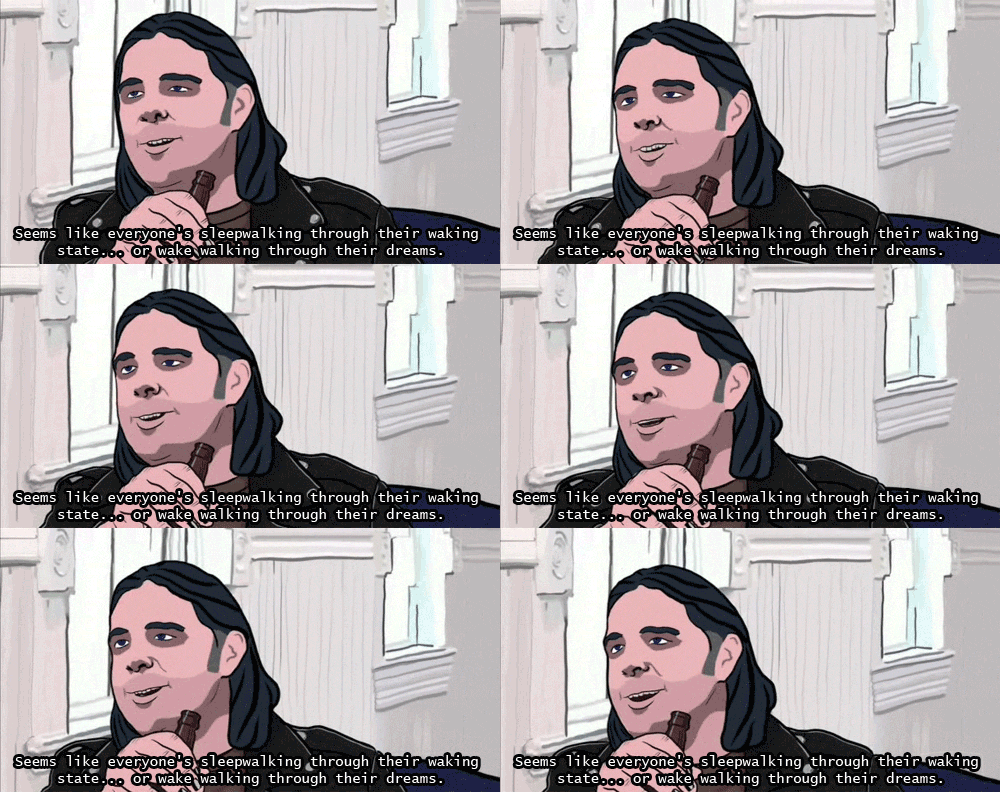
I also thought the movie A Scanner Darkly was really interesting. I liked the style of animation. Have you heard of the movie Waking Life? As I was watching A Scanner Darkly, I thought, Wow, this looks just like Waking Life, and lo-and-behind, the animation stuff was done by the same people. Waking Life was a philosophy-themed movie and it was really good! I saw it for the first time my junior year of high school and I don't think I've made it through one English class since then without bringing it up at least once; I didn't really realize I did this till now.

Waking Life


Saturday, October 11, 2014

The Reinvention of Myth in Anansi Boys

I was able to find a few people on Youtube who put up the audiobook of Anansi Boys by Neil Gaiman, so that was nice. I was happy to see that this was basically Neil Gaiman week because I had been meaning to read a book by him for a while now, and finally I had a good excuse to do so! Over the summer, I'd also started Stardust and I really liked it, but I didn't have time to finish it... maybe someday. I also remember when Neil Gaiman came to our school during the spring of my freshman year and read some of his work. I really liked it, which is what initially made me want to read more of his stories. I really like him because he seems like a really smart person who has a great mind for fantasy and creativity, plus a true understanding of humanity. So obviously I really enjoyed Anansi Boys... I could relate to Fat Charlie because Fat Charlie is like super uptight and awkward and bad in social situations, and sadly I am very similar. However, I think my favorite character was Daisy. It seemed like whenever they were together, interesting/funny things happened and cute dialogue ensued. She kind of reminds me of Lucy from Despicable Me 2 because they unsuccessfully try to be kind of badass authority figures and are both super lovable. I liked the little injections of humor in the story. They were really funny to me. They seemed like British humor, which makes sense I guess since Neil is English. It helped that the guy doing the recording for the audiobook did great voices for the characters.

I found it interesting that the story was based on the Anansi stories. I remember seeing a play and reading stories about Anansi when I was in elementary school, but it wasn't something I had thought about since then, so as I was reading Anansi Boys, it slowly came back to me. The story of the book is based on the Anansi stories, fables about a prankster spider/god in Africa who played tricks on the other animals. Anansi is represented as Fat Charlie's dad. When their father dies, Fat Charlie and Spider come together and craziness ensues. Spider is also a god, so basically he is super cool and can do some amount of magic. He is really good at picking up studs, whereas Fat Charlie is as hopeless as a leftover piece of blubber when it comes to picking up studs. The worst happens when Spider, posing as Charlie, manages to have sex with Fat Charlie's fiancé, who was previously a virgin who kept insisting to Fat Charlie that she wanted to wait until marriage. Spider again posed as Fat Charlie when he went to work in his place, and was again completely convincing, which shows his power. As the story goes on, the ties to the original fables get stronger. Bird Woman is after Spider, and eventually gives him to Tiger, who cuts out Spider's tongue, and Charlie has to negotiate with Bird Woman in a very supernatural, mystical landscape. Even though I could see that the story was based heavily on the old Anansi stories, it didn't really hurt my experience reading the book that I am not really well-versed on those stories at this point because here and there they were retold throughout Anansi Boys.


Monday, October 6, 2014

The Novel of Spiritual Education

I must say, I am really looking forward to class this week because I really like "novels of spiritual education." I'm one of those people who is really into the Harry Potter series, and I have been meaning to watch City of Lost Children for some time now... I remember as a child and teenager, in addition to my love of Harry Potter, I really liked books such as the Guardians of Ga'Hoole series and the Charlie Bone series and The Mysterious Benedict Society, which are also novels of spiritual education.

For this week, I read The Magicians' Guild by Trudi Canavan. I actually thought that Night Circus and The Magicians sounded more interesting from their summaries that I read, and maybe I'll read them later on in life. However, I ended up reading The Magicians' Guild since it was the only book that was available online. I didn't like it as much as I hoped to. I didn't feel much of a connection with any of the characters, which is important for me. It also wasn't written in a style that appealed to me. I guess I am not really into super straightforward writing styles. I remember being really excited for The DaVinci Code too, but the writing style reminded me of reading a news article, so it was too boring for me to finish. This is how I felt about The Magicians' Guild. I tend to like books where the writing style is either like real-time storytelling, like with Harry Potter, A Series of Unfortunate Events, and The Hobbit; or poetic, like Ray Bradbury's writing; or if it's in a way where you really feel like you're in the character's head like in The Perks of Being a Wallflower, or just weird, like Chuck Palahniuk's writing. This is kind of bad for me because most books are written in that very straightforward way, and it makes them less interesting for me. As I said before, another important thing is character development, and I can still get into a book if it has that, but I didn't feel like The Magician's Guild had really very interesting character development either. Not that it was a bad book or anything; I can see why some people would really like it. It just wasn't my favorite.

Anyway, in this book, the source of spiritual education is the Guild, a group of administrators for the country of Kyralia. One of the major values of the Guild was adhering to tradition. For example, early on in the book, when the members of the Guild were proposing ideas on what to do about the rogue magician, a female guild member was the one who wanted to accept her into the Guild and educate her, because she wanted another healer in the Guild, and apparently women in the Guild generally become healers, so the guild follows traditional gender roles. Also, when Dannyl touches the hand of a girl in the streets and feels the amount of power she has, he starts thinking about what she would be able to do with the power. He thought that she would probably be used in her family to do tasks for them, and then she would get married off to strengthen the family's name. If she were a boy with the same amount of power, things would be different for her. He thought about this very matter-of-factly. In addition to adhering to old gender roles, the entire conversation had a feeling of old-fashionedness and wanting to do things the way they've always been doing them. It seems like it's a common theme in books about magic for the "good guys" in the story to be going against the way things have always been done. This made me think about how really conservative people are sometimes against books about magic, and maybe this is part of the reason why; conservatives tend to want to stick to old traditions and these books often push against that idea. A big part of the guild's purpose is to get the "dwells" out of the streets of the capital city. The dwells are poor people, and the Guild drives them away each year. The main character, Sonea, wants nothing to do with the Guild because of what they do to the dwells. She is against their old traditions. The society has a very strict and obvious caste system, with the dwells at the bottom and the Guild at the top. It's to a point where the servants for the magicians have to wait for the magicians to say "Speak" before they can say what they came in to say.

As one would expect, there are a lot of parallels that can be drawn between this story and Harry Potter. The biggest similarities are that there is a magical society where people train to learn how to use magic, and that the main character has the magical power but doesn't realize that they have it at first. Another similarity is when Sonea realizes that the magicians are trying to find her mentally, but she is able to block them, and the magicians say that they aren't sure if she is blocking them, because most people have to be trained on how to do that, and they don't think she has received any training. This is like when Snape is trying to teach Harry how to block Voldemort from sending Harry mental pictures, except apparently in this world it's not as hard to do that. On the other hand, there are some elements of realism that weren't in Harry Potter, probably because this book was written for older people. For example, when two girls are complaining about men "hassling" them, like catcalling and harassing them. Sonea says the reason she got short hair was to try to stop this from happening as much, but looking more boyish ended up having its own set of negative consequences.

Also, here is a random fact about a Harry Potter-related experience I had:

A lot of people in America seem to have never heard of this, but there is a place in the suburbs of London that is owned by Warner Bros. and it is basically these two huge connected warehouses, plus a backlot, that are where much of the Harry Potter movies were filmed, and now it's basically a museum that is stuffed full of props, sets, and costumes from the movies. I went this summer, and it was one of the most amazing things I've ever seen! If any of you have the chance of going here, you definitely should... It was one of the most expensive parts of my trip, but for all the tears and awe it inspired in me, and for the fact that I was able to spend about seven hours here pretty easily looking at everything, I think it was worth it. So please go do this ASAP!! I sound like Tony Rice.

Hufflepuffs fo life!!

Wednesday, September 24, 2014

Response to The Hobbit

I liked The Hobbit by J.R.R. Tolkien SO much more than I thought I would! In the past, I'd had bad experiences with Hobbit-related things, so I had really low expectations for the book. For example, when I was in elementary school, I tried reading it because my dad told me he thought I'd like it... I found it really boring though, and I never finished it. Then, when The Lord of the Rings movies came out, I tried watching those and also found them even more boring. Then the two Hobbit movies were released. I watched the second one, The Desolation of Smaug, with my dad, and I still found it super boring. However, it was available as an audiobook, and I figured it would be easier to listen to the book than actually read it because then I could listen to it while I worked on menial tasks and kill two birds with one stone. So I decided to give it a try. I was really glad I did because I loved this book! I wouldn't say it's in the top five books of all time, but it was really good. The vibe of this book seemed completely different from the second Hobbit movie. This book was adventurous and had a good vibe of camaraderie. The movie was really lacking the heart that the book had. I've never read the Lord of the Rings books, but I saw parts of the movies, and The Desolation of Smaug movie reminded me too much of the LOTR movies...in a bad way, because they were super drawn out with boring characters who lacked personality. I think they did this on purpose to make the story more manly so that they could appeal to people who like manly action movies, which is tons of people. Like maybe if the movie had too much cutesiness it would only appeal to really dorky fantasy reading people. But I would have liked it better this way! I kept falling asleep during the movie. The book was super interesting! The only part of the movie that I liked was the barrel scene, even though it was really different from the barrel scene in the book, which wasn't crazy and action-packed like it was in the movie. I found a fun video about how they made the scene, if you're interested. It looks like the most fun scene to film ever:

Anyway, like I said, the parts of The Hobbit that appealed to me, and the parts of The Hobbit that appealed to the movie director were completely different I guess. For me, I really liked the parts with the character interactions and descriptions of their feelings and personalities. I loved the descriptions of Bilbo. He was adorably polite, like in the very beginning when people kept coming into his house, and he would serve them food and drinks and try to be really polite, while in his head he was worrying that he would run out of food. He ended up serving them the little cakes that he had been planning on eating later that day for lunch. Little details like that were my favorite parts of the book. 

To me, the funniest part of the book was in Chapter 7, when Gandalf, Bilbo, and the dwarves went to Beorn's house, but they didn't want to upset Beorn with all the people, so Gandalf told the dwarves to enter two at a time, every five minutes, and say something along the lines of "We are pleased to be of service to you." But it ended up not really working out that well and just being really awkward. I didn't describe it in a funny way, but in the book it was super funny! 

On many occasions, Tolkien did that thing where he kind of breaks the fourth wall and says something like, "But that's another story that we won't talk about here." I remember at one point, there was a chapter that ended with something like, "But then the hobbit realized... this part of his story had to continue in the next chapter!" I thought these things were cute. I had seen them a lot in other books, but the other books I saw it in were more recent, so it made me wonder if Tolkien was the first to do this or if he had just seen it in other books too and decided to adopt it. 

I'm sure that people already know about this and are tired of hearing about it, but I guess I may as well bring up the fact that this book is strongly reminiscent of the hero's journey. There are tons of stories that have it (e.g. Harry Potter and The Lion King), but it seemed to be even stronger in this book. I didn't mind this. It's not a boring plot structure and the actual events and characters were original. It kind of reminded me of The Lego Movie because Emmett was like Bilbo in some ways. They were really simple people who weren't particularly strong or amazing but still lovable because it made it easier for us commonfolk to relate to them.

In conclusion, this book had such a good vibe to it that the movie was totally lacking. It gave me a similar mood to the mood that I get around Christmastime, or when I go on the (now gone!!) Maelstrom ride at Disneyworld, or when I watch Labyrinth, or read the first few Harry Potter books. It made me feel like baking cookies and bread, and watching claymation movies, and building blanket forts, and going out to enjoy nature. I'm pretty sure this is really different from how a lot of people feel when they read the book, considering the nature of the movies. Maybe I should give the animated movie a try!

I think this scene would have been even better with this song!

Friday, September 19, 2014

The Witches in Aunt Maria

Aunt Maria by Diana Wynne Jones was a pretty interesting book. As I was reading it, I could totally see it being made into movies. The first half of the book felt like it could be a Miyazaki movie. It had all the Miyazaki trademarks: wind, cats, kids, old people, beige houses by the ocean, goblin-reminiscent forests, spirits, shopkeepers, people saying "Good afternoon!", and a wolf, particularly one that was originally a human but then turned into its animal state. It had a mixture of parts that were calm, thrilling, mysterious, supernatural, and quirky. To me, the writing style was reminiscent of the early Harry Potter books. It was kind of children's book-ish and whimsical, but still exciting. Towards the end of the book, the pace of the story picked up and it got weirder. It wasn't until almost halfway through the book that we found out Aunt Maria was a witch. It was here where things got a bit suspenseful, because Mig knew that Aunt Maria had turned Chris into a wolf, but she wasn't supposed to know, and if Aunt Maria realized that Mig knew, Mig would probably receive an equally bad fate and then she wouldn't be able to help herself or anyone else. While the first half of the book felt like a Miyazaki movie, the second half felt like it could be a Laika movie. It dealt with the supernatural a lot and had a wide cast of peculiar characters and circumstances, with an epic, mostly-happy ending. I really liked this book overall; I liked the tone of the story and the diction of the writer. It felt a bit nostalgic and innocent, like a breath of fresh air. I think I remember getting this feeling from Diana's book Howl's Moving Castle, although I read it so long ago that I don't totally remember. I guess from the diction of the writing, I got the sense that the author cared a lot about the feelings and processes that Mig went through, and that made me care too.

The witches in Aunt Maria weren't exactly straight-up witch stereotypes, but I did feel like I'd seen similar characters in the past. One that came to mind was Dolores Umbridge from the Harry Potter series. Like Aunt Maria and the Mrs. Urs, she was bitchy despite appearing to be a sweet old lady at a distant first glance. She would shroud herself in pink and cuteness, which seem like something a helpless, nice little old lady would do, but she had a power complex and was sometimes cruel. Aunt Maria was very similar in this way. She didn't seem to be strongly guided by morals. She mostly just bossed people around and bothered them. For example, even though she was capable of buttoning her corset, she made other people do it for her. She also made Mig's mother buy and cook food for her. When Mig's mother bought a cake instead of making one herself, Aunt Maria was really mean and snotty about it. The other Mrs. Urs were too, to varying degrees. From the start, one could see that Aunt Maria was mean and frumpy and lazy and obnoxious. However, she seemed more like a stereotypical old lady with dementia than a stereotypical witch who is thin and warty with a black hat. She would often invite a group of friends over for tea and dessert, and her friends were pretty similar, some nicer, some meaner, and some crazier and some saner, but all were kind of similar. Elaine was the meanest one, and came over the most frequently. As the story went on, it turned out that Aunt Maria had more power than we knew about originally. On page 72, Aunt Maria turned Chris into a wolf because he was badmouthing her and accusing her of murder. This was the first time that Aunt Maria actually showed her magic, and it was revealed that all her friends could also do magic. They weren't like stereotypical witches who were constantly doing magic in their day to day lives. It seemed like something that was only done out of necessity, and generally was kind of a weird roundabout way of solving the problem. I wasn't quite sure, for example, why Aunt Maria made it impossible for Mig's mother to realize that Chris hadn't been home, but she didn't make it impossible for Mig to realize. Either she was really smart and knew that even if Mig did notice, she wouldn't be able to do anything about it, or Aunt Maria was just being her weird self. I guess the biggest non-stereotypical thing is that generally there's not a group of crazy old stuffy ladies running a town.

Favorite quotes:

"Oh dear. I think Hester Bayley may be as dotty as Zoe Green
underneath. Or she doesn’t know better. Mostly the pictures were
of fairies, little flittery ones, or sweet-faced maidens in bonnets, but
there were some that were so queer and peculiar that they did
things to my stomach. There was a street of people who looked as if
their faces had melted, and two at least of woodlands, where the
trees seemed to have leering faces and nightmare, twiggy hands.
And there was one called ‘A naughty little girl is punished’ that was
worst of all. It was all dark except for the girl, so you couldn’t quite
see what was doing it to her, but her bright clear figure was being
pushed underground by something on top of her, and something
else had her long hair and was pulling her under, and there were
these black whippy things too. She looked terrified, and no wonder.
‘Charming!’ Chris said."

"Really it is difficult having a martyred crusading saint for a
mother sometimes. "

Monday, September 15, 2014

What is "Weird"?

For this week, I watched the movie The Cabin in the Woods and I read Lullaby by Chuck Palahniuk, two works that fit into the critical category of "weird."

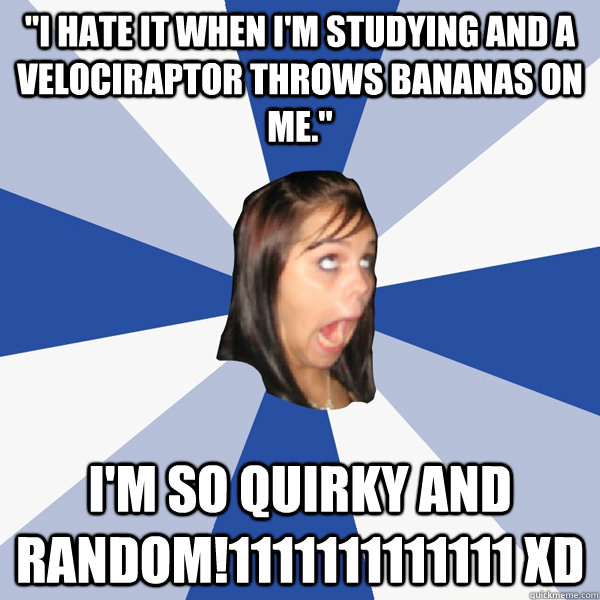
The word weird has so many different meanings, depending on who you go to. It is a word that is thrown around casually to describe people and feelings. It's become a really casual term, like the word "love." Also, like someone said in class earlier, it's become popular these days to braggingly call yourself "weird" or "quirky," kind of like how it's recently become popular to ascribe various mental illnesses to yourself. It's been in fashion lately for people to try to stand out more, but stand out in a way that's still socially acceptable. There are certain mental illnesses that people over-diagnose themselves with, and others that people shy away from. There are certain "weird" and "quirky" attributes that people will try to absorb, and others that people still have stigma toward. This has become so popular it has a meme now!

It seems like people are always trying to decide which level of clichéness they're okay with for themselves, and they judge whoever is on a lower level of clichéness. But they also judge some of the people who are on a higher level, and some of the people who are on the same level, like they feel like what they're doing is more genuine than what other people are doing. In general, though, I think this trend is nice for kids because I think it might decrease bullying a little, and nice for people in general because it makes you feel a little safer to reveal parts of yourself that you normally wouldn't.

To me, the term is something that is more of a feeling that we apply a word to than a word that can be easily described. It's easy to call something weird, and know when something is weird, and if someone else calls something weird, you can usually agree with them. I think that it's not as easy to pinpoint exactly what makes one decide that something is weird, though. Sometimes if you look at two different things that you truly believe are both weird, it can still be hard to find a connecting line between them that originally made you decide both of them are weird.

The word weird also has a dictionary definition.
1) involving or suggesting the supernatural; unearthly or uncanny:
a weird sound; weird lights.
2) fantastic; bizarre:
a weird getup.

The dictionary definition gets closer to my interpretation of the critical genre of the "new weird." I had actually never heard of this genre before my introduction to it in this class, but I think I can see what the meaning of the term encompasses. I was never sure what a book like Lullaby by Chuck Palahniuk would be classified as. I probably would have lumped The Cabin in the Woods into the horror genre, but there is definitely more to it than a normal horror movie. "New weird" makes sense as a genre for both of these works. They both take something that we've seen before, but put a spin on it that makes it really unique. Both The Cabin in the Woods and Lullaby are based in the horror genre, but they're done in a unique way.

A side fact is that in high school I was really into Chuck Palahniuk. I read Fight Club, Diary, Haunted, Survivor, Invisible Monsters, Choke and part of Pygmy (though I didn't finish it because I didn't like it). It was actually just as I was about to start reading Lullaby, which was next on my list, that my parents said, "Hmm, we see that you have been into this Chuck fellow lately. Let's see what this is about!" As you might already know, Lullaby was influenced by the brutal murder of Palahniuk's father and girlfriend. So, my parents were really disturbed by this and decided to ban me from reading any more of Chuck's books. So I finally read the book that I had initially set out to read about four years ago! Lullaby was definitely very similar in writing style to Chuck's other famous books. It had the same use of short choppy sentences and repeated phrases and lack of certain types of punctuation. One difference in the writing was that this one alternated between past and present tense. Also, this was the first horror genre story I'd read by him. Diary had supernatural elements too but this one had them more strongly. Other parts of this book reminded me of Invisible Monsters. Though I don't remember Invisible Monsters super well, I remember there was a group of weird characters who went on a sort of road trip. Lullaby also featured a weird cast going on a road trip, though their road trip had more of a purpose. They also both had nonlinear structures.

From Lullaby and The Cabin in the Woods, I think it might also be safe for me to gather that works in the "new weird" genre have their own unique, satirical tones. Lullaby's tone is witty, meticulous, and dry. The Cabin in the Woods' tone is rather tongue-in-cheek, comedic, and heavily satirical. At points in the movie, it also had a shallow tone, which was intentional. They used this shallow tone for the parts where the "gamemaker"-type people putting the movie together were working or talking or partying afterward. They were disconnected from the feelings of the people in the movie and were very business- and money-oriented. Their shallow lack of empathy added to the satire feeling of the movie because it was shown back-to-back with characters in sheer terror and confusion. It trivialized the feelings of the people in the movie-within-the-movie. It was very different from the tone of a normal horror movie.